
Same-Day & Emergency Pest Control
Stung by Yellow Jackets? When a Ground Nest Is Urgent
A yellow jacket ground nest is an emergency when it sits where people walk, mow or play, or when anyone near it is allergic to stings. If you were just stung, walk away from the spot, leave the mower where it is and call 911 for trouble breathing or swelling of the face before you do anything else.
- Serving Columbus since 1990
- 4.5★ from 55 Google reviews
- Owner-run, based on Dunning Rd
- One-time or recurring service
Below is how to tell whether a nest is urgent, what to do in the minutes after a mowing accident, and how a ground nest gets treated.
Is a yellow jacket ground nest an emergency?
Sometimes. Ground nests are hidden, so the risk is not size but where people step and mow.
- Call today: the hole is in a path, near a patio or a play area, beside a steps or a mowing line, or you have already been stung.
- Call today: anyone in the household or a regular visitor has a known sting allergy.
- Call today: you see insects entering the house near the same spot.
- Can wait for the next opening: the hole is at the far edge of the property, nobody goes near it and you can keep people away.
If you are not sure, treat it as urgent and describe it on the call. Our page on same-day nest removal explains how we decide, and a nest does not become less dangerous because it is out of sight.
Stung near a hole in the lawn?
Stay away from the spot and call. We will tell you whether the nest needs attention today.
- Serving Columbus since 1990
- 4.5★ from 55 Google reviews
- Owner-run, based on Dunning Rd
- One-time or recurring service
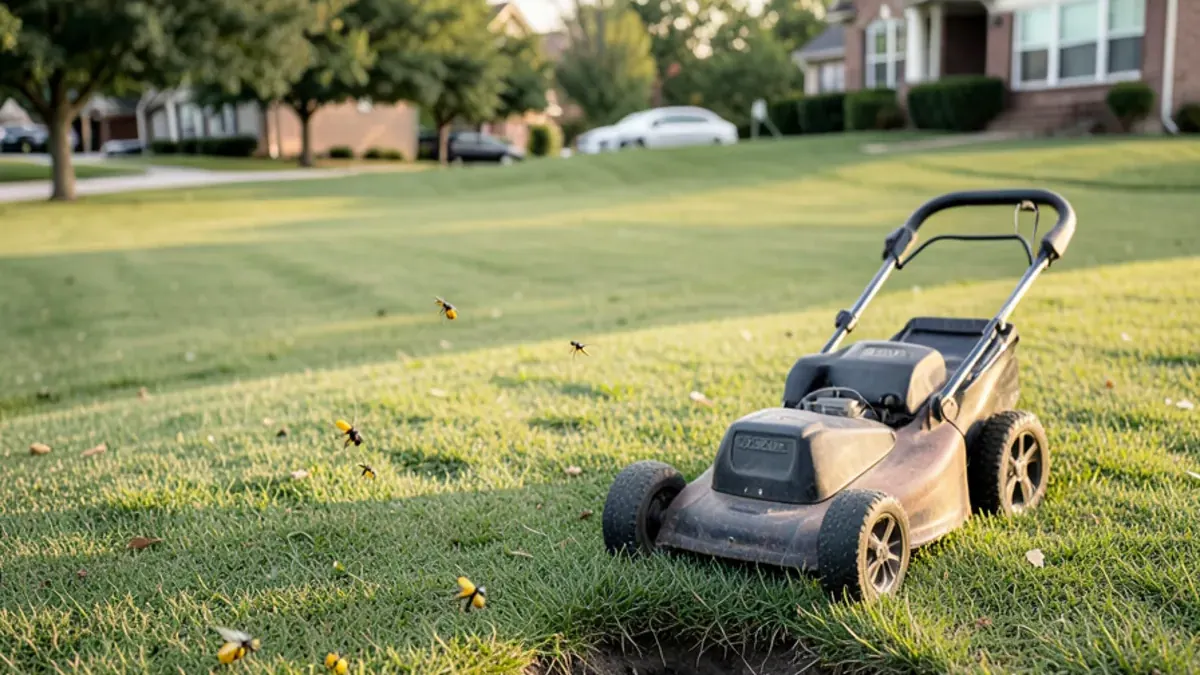
What do you do right after mowing over a ground nest?
- Leave the mowerDrop the handle or step away from the machine. Yellow jackets attack the vibration, and a stalled mower can be retrieved later.
- Move away fastCover your face and head with your arms and get indoors. Running in a straight line works better than swatting.
- Check for stingsOnce inside, look at arms, neck and scalp. Wash any sting sites.
- Watch for a reactionStay alert for the next several minutes. Trouble breathing, swelling of the face or throat or dizziness means 911.
- Call for the nestDescribe where it is. Do not go back to look at it.
When is a yellow jacket sting a medical emergency?
Other signs that deserve a doctor's attention include hives spreading beyond the sting site, dizziness, nausea, a rapid pulse or a sting inside the mouth. Many stings at once can be a problem even for people with no allergy. If you have been prescribed emergency medication for sting reactions, use it as your doctor directed.
A typical sting hurts, swells and itches around the site. Wash it, cool it and keep an eye on it. Yellow jackets can sting repeatedly, so a victim may have several stings and not know.
Why do yellow jackets turn up in Westerville yards in late summer?
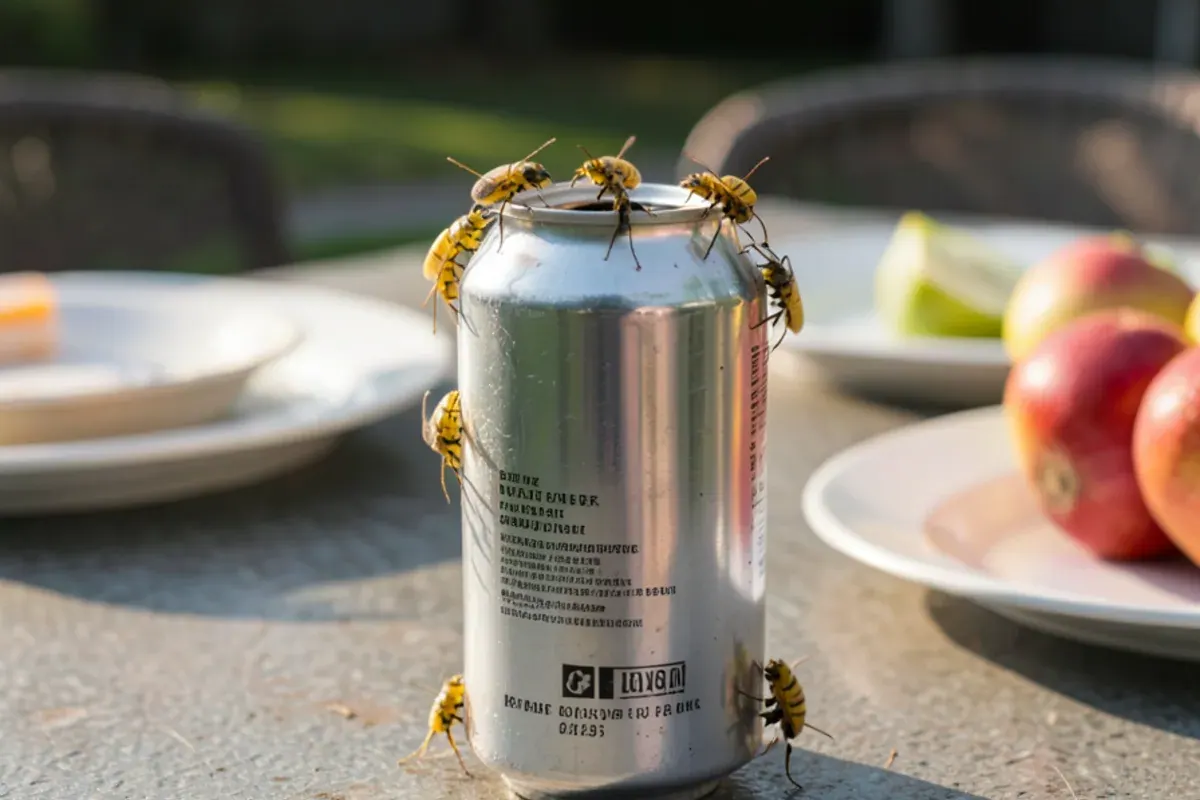
A colony grows all summer from a single queen, and by August a large crowd of workers is foraging. They stop eating as much protein and chase sugar, which brings them to soda cans, fruit and trash. A hidden nest in the lawn becomes a problem at the same moment backyard cookouts peak.
Westerville's median home was built around 1982 (U.S. Census ACS 2019 to 2023), so many yards have older stumps, steps and retaining walls where a queen can find an abandoned burrow. Nothing about it is unusual. It is simply what an established neighborhood looks like to a queen in spring.
How do you keep a mowing run or a cookout from setting off a nest?
A few habits cut the odds from August on, when colonies are at their largest. None of them replace treating a nest you already know about.
- Walk the lawn edge at midday before the first mow of late summer and watch for insects flying into one spot.
- Look along retaining walls, stumps, mulch beds and the base of steps, where queens find old burrows.
- Keep trash and recycling bins lidded, and rinse cans and bottles before they go out.
- Cover sweet drinks and food at cookouts, and check a can before you take a sip.
- Pick up fallen fruit under trees and keep pet food indoors.
- Fill abandoned burrows in fall once the traffic is gone.
Do not plant a flag or a marker beside a hole. Walking close enough to do it is the thing that gets people stung. Note the spot against a fixed landmark such as a downspout or a fence post, and describe it on the call.
How do you find a ground nest without getting stung?
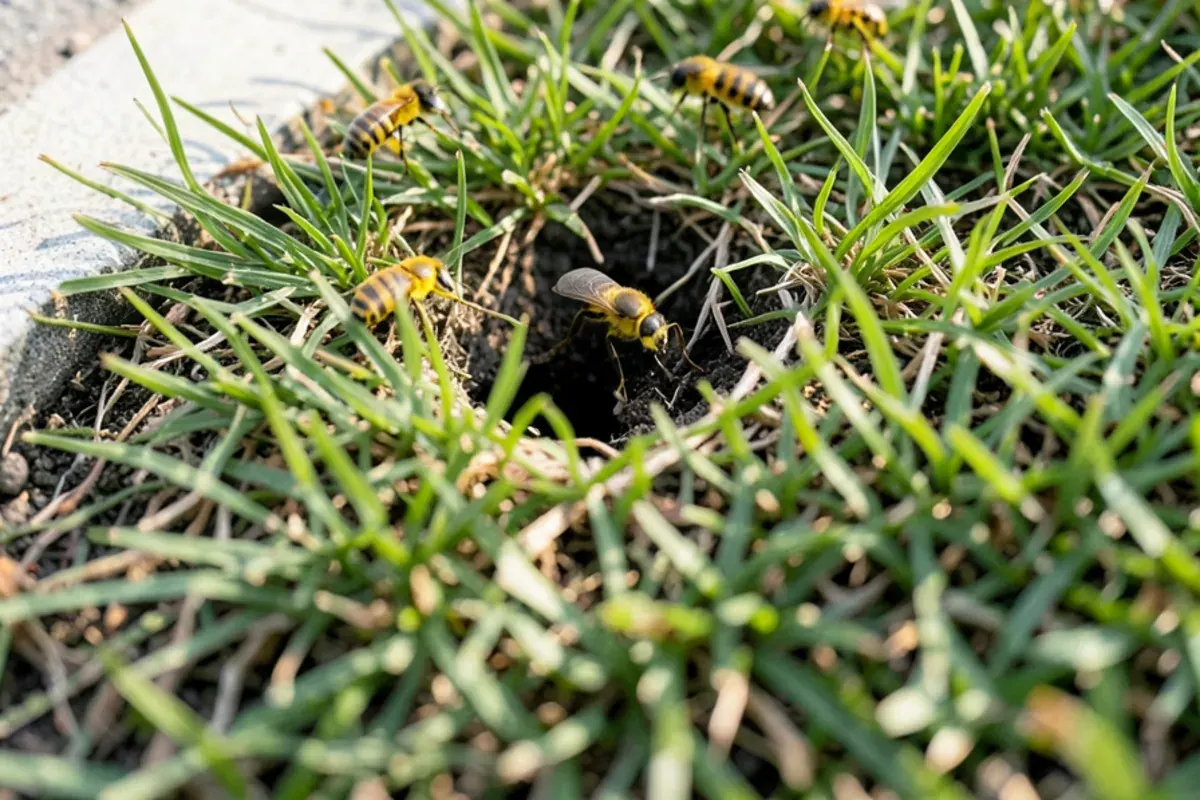
Watch from across the yard on a warm, sunny day, when traffic is heaviest. You are looking for a steady line of insects flying into and out of one hole about the size of a dime. Do not walk toward it, and do not lean down for a better look.
Skip the folk remedies. Pouring gasoline, water or soap into the hole sets the colony off, and gasoline harms soil and groundwater. Blocking the hole may push the colony into a wall or foundation gap. A flashlight at night draws them to you.
Is it a yellow jacket nest or another hole in the lawn?
Not every hole in the grass is a nest. Ground-nesting solitary bees dig small holes ringed by a mound of loose soil, and the bees fly slowly and sting rarely. Ants build mounds too. A yellow jacket entrance usually has no mound, and the insects come and go in a fast, direct line, with several at the opening at once.
Look from across the yard. If traffic is steady and the insects fly low and fast, treat it as a nest. If you only see one or two slow bees over a patch of bare soil, send us a photo and we will help you tell.
How is a ground nest treated?
We find the real entrance first, since treating the wrong hole does nothing, and then apply a labeled product at the opening per label directions. We ask about pets, kids and allergies before the visit and plan around the answers. Activity should fade over the following days as the colony dies.
A visit the same day depends on the schedule. Westerville is about 15 minutes from our Dunning Rd base, and a review mentions hornet jobs done the next day when today was full. Call early and we will tell you what is possible. You hear the price before work starts, and it depends on the nest.
What if the nest is in a wall void, a retaining wall or under a deck?
Yellow jackets use any sheltered cavity, so the entrance may be a gap in a stone wall, a crack beside a step or a hole at the base of a deck post. These jobs take more care, because the colony is bigger than the opening suggests. Plugging the opening may push the colony into the house, which is the same reason we warn against blocking a hole.
A nest in a wall or foundation can need a second visit, and we tell you that before the first one. Once activity stops, the gap gets sealed so a new queen has nothing to move into.
What we tell people with a ground nest
Pour nothing, plug nothing and stay away. We ask where the hole sits, whether anyone has been stung and who in the household has an allergy. The answers decide how high the call goes on the list.
After treatment, we tell you when the lawn is ready for mowing and when to call if traffic continues. Once the nest is dead, you can fill the hole. The old nest is never reused, though another queen may pick a similar spot next year.
Ground nests have limits. A treated nest can still show a few stragglers for a day or two, and a colony in a hard-to-reach cavity may need a return visit. If the nest sits in a neighbor's yard and the traffic crosses the fence, we cannot treat their property, so the first step is a conversation with them, with a photo in your hand.
Calling is not always worth it. A few yellow jackets on a soda can do not mean a ground nest in your yard. They may come from several blocks away. Call when you see a steady line into one hole, when a mower has hit a spot or when someone has been stung.
Related questions
Can I wait for winter to kill a yellow jacket ground nest?
The colony dies after a hard freeze, but that can be weeks away, and the nest is most dangerous in the meantime. If the hole is near a path, a patio or a mowing line, do not wait. Keep people away and call.
Will yellow jackets reuse the same nest next year?
No. Only new queens survive the winter, and they leave to start fresh nests in sheltered spots. A new queen may choose a similar hole nearby, so fill abandoned burrows once the activity ends and keep an eye on the same part of the yard in spring.
Are yellow jackets worse than other wasps?
They are among the most defensive. Yellow jackets guard a hidden entrance with many insects at once and sting repeatedly. Paper wasps are usually less aggressive and give a warning before they sting. Treat any ground traffic with caution.
What if my dog or child got stung?
Move them away from the spot and call 911 for trouble breathing or swelling of the face. For a pet, call your veterinarian. Then call us about the nest so nobody else walks into it.
When can I mow again after a nest is treated?
Wait until the traffic at the hole has stopped and the product's label directions are met, and we will tell you which day that is. In Westerville, about 15 minutes from our Dunning Rd base, we usually give that answer on the same call. If a few insects linger, keep off the spot another day.
If you found a ground nest or just mowed over one, stay clear and call. Our same-day nest removal page explains the timing, and (209) 563-1650 reaches us directly. We serve Westerville and the rest of Columbus, and we will tell you whether your nest needs attention today. A hornet instead? See what to do if you found a hornet nest.
Sources
Questions about this? Call the shop.
Tell us what you are seeing and we will tell you what happens next.
- Serving Columbus since 1990
- 4.5★ from 55 Google reviews
- Owner-run, based on Dunning Rd
- One-time or recurring service
Boydes Exterminating Co, 1967 Dunning Rd, Columbus, OH 43219