
Same-Day & Emergency Pest Control
Found a Hornet Nest in Columbus? What to Do First
Found a hornet nest? Walk away calmly, keep people and pets out of that part of the yard and leave the nest alone. Do not spray it, knock it down or block the entrance. Take a photo from across the yard, then call us. Trouble breathing or facial swelling after a sting means 911 first.
- Serving Columbus since 1990
- 4.5★ from 55 Google reviews
- Owner-run, based on Dunning Rd
- One-time or recurring service
The rest of this guide covers the first hour, what makes a nest urgent, how fast a visit can happen and what late-season timing changes.
What should you do in the first hour after finding a hornet nest?
- Move away without swattingBack off slowly. Waving your arms or swatting at the insects tells the colony the threat is real.
- Clear people and petsBring kids and animals inside and close doors or windows near the nest. Keep lawn equipment out of that corner.
- Photograph from far awayUse your phone's zoom from across the yard. Capture the whole nest and what it hangs from. Do not use a flash.
- Note the detailsWrite down the height, the size, the nearest door or path and whether anyone in the home has a sting allergy.
- Call early in the dayEarly calls leave more of the day to work with. Same-day visits happen when the schedule allows, and we say so honestly on the call.
Nest near a door or the kids' play area?
Call early and tell us where it sits. Same-day visits happen when the schedule allows, and we will say plainly if today is not possible.
- Serving Columbus since 1990
- 4.5★ from 55 Google reviews
- Owner-run, based on Dunning Rd
- One-time or recurring service
Is it a hornet nest, a paper wasp nest or a yellow jacket nest?
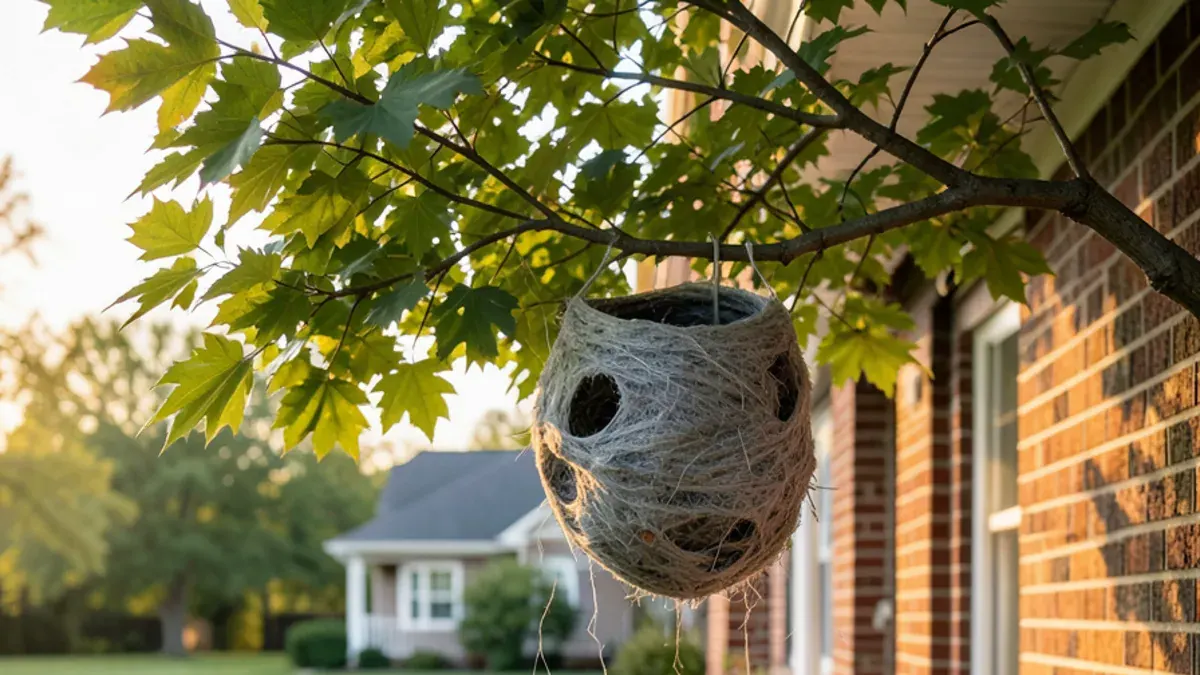
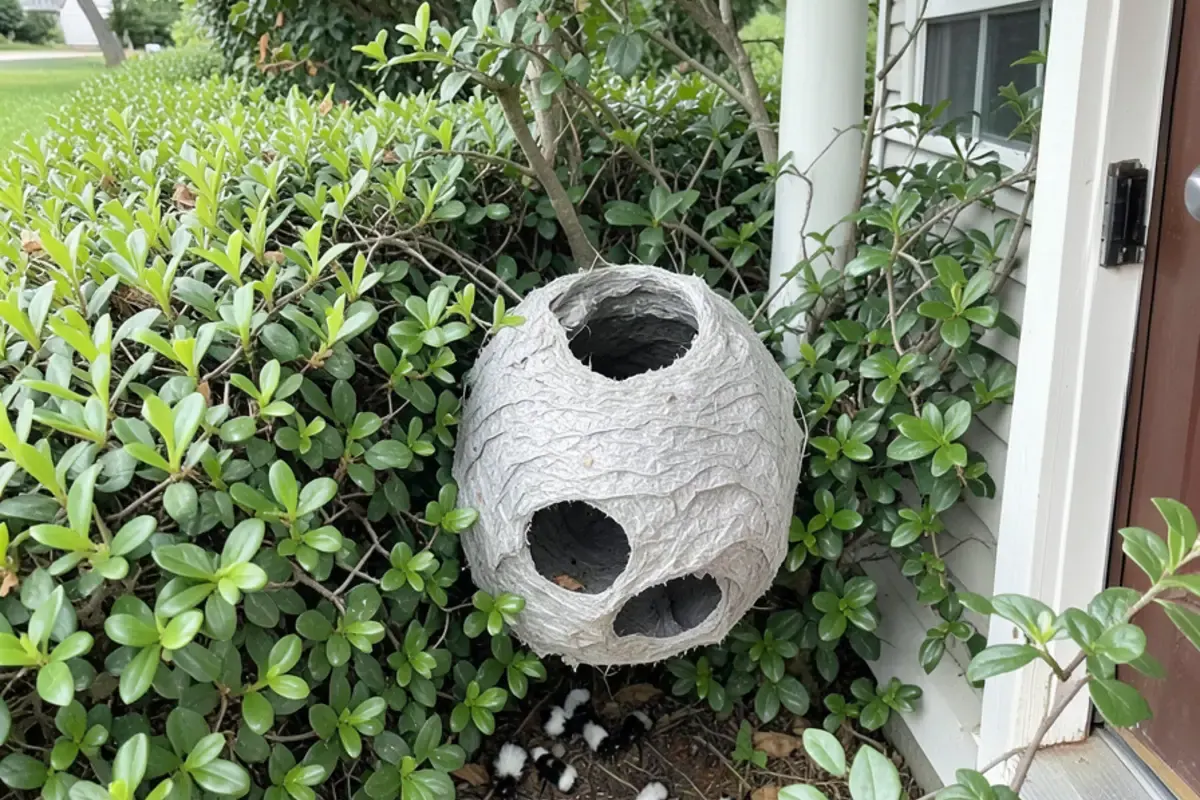
The answer changes the plan, and a photo from across the yard is usually enough to tell. Bald faced hornets build a closed gray paper nest, shaped like a football or teardrop, with one opening near the bottom. Paper wasps build an open comb, like a small umbrella, with the cells in plain view. Yellow jackets nest in the ground or inside wall voids, so you often see traffic at a single hole and no nest at all.
| What you see | Likely insect | What it means |
|---|---|---|
| Closed gray ball or teardrop on a limb, shrub or eave | Bald faced hornet | Large colony by late summer, so keep well back |
| Open comb with visible cells under an eave or rail | Paper wasp | Smaller nest, still a problem beside a door |
| Steady traffic at one hole in the lawn or a wall | Yellow jacket | Read our post on the yellow jacket ground nest |
| Insects entering a hollow tree, shed or wall void | European hornet or yellow jacket | The nest is out of sight, so a photo of the entrance helps |
Do not walk closer to confirm. If the photo is blurry, send it anyway and describe where the traffic is. We can usually narrow it down from that.
What should you never do near a hornet nest?
Hornets defend the nest hard, and several instincts people have about nests make things worse.
- Do not spray from close range. A stream that reaches the nest also tells every guard where you are standing.
- Do not knock it down or hit it with a hose. Hornets that lose a nest do not leave. They swarm the nearest target.
- Do not cover or plug the entrance. Trapped insects look for another way out, and sometimes that is inside the house.
- Do not trim, mow or run a trimmer beneath it. Vibration alerts the colony.
- Do not use fire, smoke or fireworks. Besides the sting risk, you can set the house or a tree on fire.
What if hornets are already getting indoors?
Close the door to that room and watch where they come in: a window frame, a light fixture, a vent or a gap around a pipe. A steady flow of hornets inside with no nest in sight often points to a colony in a wall void or attic. That is the case where you should not caulk or block anything yourself, because the insects will look for another way out.
Keep everyone out of that room and leave the lights alone. Then call, and tell us which wall or ceiling the traffic seems to come from.
Is a hornet nest an emergency or can it wait?
| Where the nest is | Urgency | Why |
|---|---|---|
| Beside a door, walkway or garage entrance | Call today | People pass within a few feet every day |
| Near a play area, pool or patio | Call today | Kids and pets move around unaware |
| Anyone in the home has a sting allergy | Call today | One sting can be dangerous |
| Insects getting inside the house | Call today | The colony may be in a wall or attic |
| High in a tree, far from traffic | Regular opening | Nobody comes near it, so it can usually wait |
Calling a nest urgent does not change the schedule, so we would rather tell you honestly which column yours is in. Our page on same-day nest removal explains how we decide.
How fast can a hornet nest be removed in Columbus?
A same-day visit happens when the schedule allows. It opens up when earlier jobs end early, when someone cancels or when we have room in a route near you. Customers mention same-day service in reviews, and one review describes hornet jobs done the next day.
The drive helps. Our Dunning Rd base is about 7 minutes from central Columbus and about 11 minutes from Gahanna, where the Big Walnut Creek corridor is lined with mature trees that give hornets plenty of limbs to choose from. Close calls with a nest by a door move up the list. A nest high in a tree far from the house waits for a normal opening.
We are not a 24-hour service. We work set hours, closed Sunday, so a nest found on a Sunday waits until Monday. For the full picture, read our emergency pest control overview.
Why do hornet nests get worse from August on?
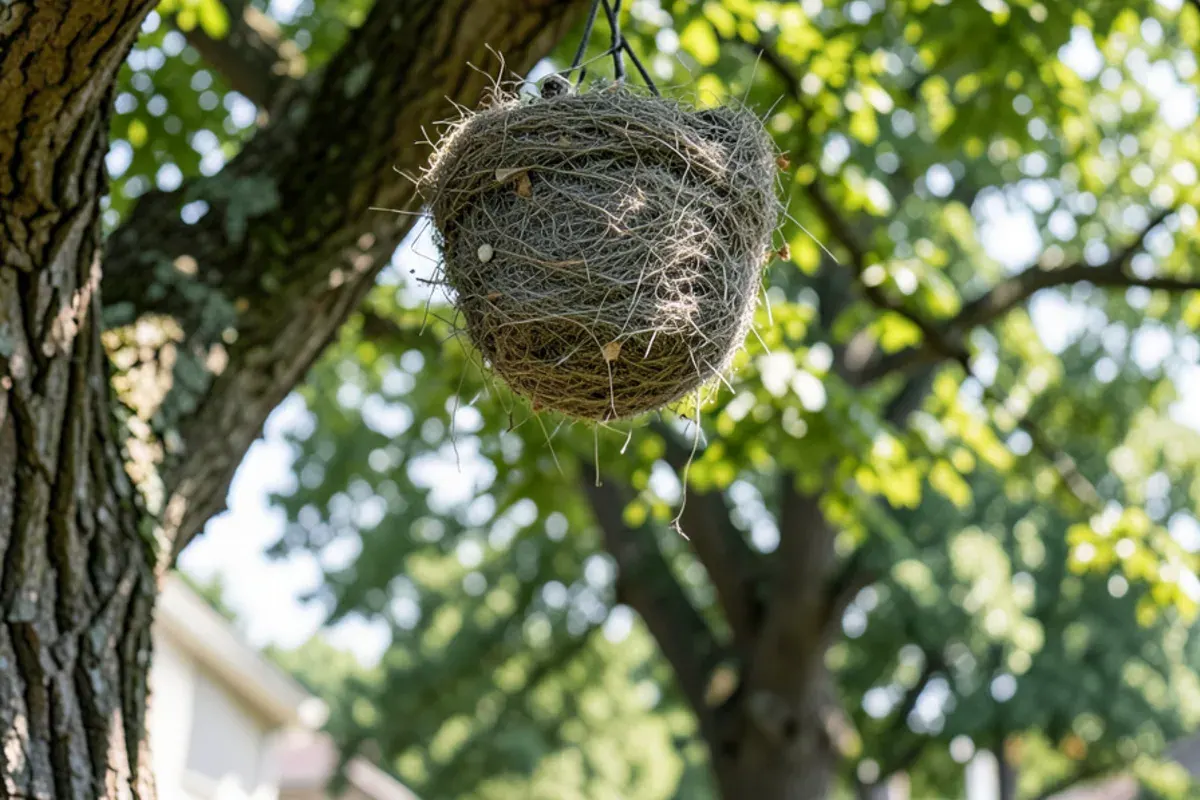
A queen starts the nest alone in spring, and each wave of workers adds paper and defenders. By late summer a bald faced hornet nest can be the size of a basketball, with many more guards than in June. Hornets are also more irritable then, and a nest you walked past in July can become a problem by September.
Colonies die with the first hard freeze, and the old nest is never reused. If you find one in November, the colony is already gone, and removing the paper is a choice, not a necessity. If you find one in August, plan on action.
Can you remove an old nest in winter?
After a hard freeze the colony is gone, but a single cold night may not finish every hornet inside. Ohio State University Extension's BYGL notes that nests collected in winter can still hold live hornets, particularly early in the cold season. Wait for a sustained freeze, watch the entrance on a mild afternoon and only touch the nest if nothing is moving.
Old nests also fall apart over winter. If it hangs over a path, taking it down is tidy. If it sits high in a tree, it can stay until it drops.
What if someone gets stung?
Move away from the nest first, since more stings follow if you stay. Then wash the area, apply a cold pack and watch the person for the next several minutes.
Multiple stings, a sting inside the mouth, or any history of severe reactions also warrant a call to a doctor. Bald faced hornets can spray venom toward the eyes, so rinse well with water and get medical help if they burn.

What we ask on the call
We ask where the nest is, how big it looks, how high it hangs and who walks nearby. We also ask about allergies, pets and kids, and we plan around the answers. That tells us whether the call goes to the top of the list.
If you can send a photo, send it. A closed gray ball in a tree tells us it is probably a hornet nest. An open comb under an eave tells us something different, and a wall full of traffic and no visible nest is a third problem. Price depends on the type and extent of the nest, and you hear it before work starts.
Hornet jobs have limits, and we tell customers where they are. A nest in a wall void or attic may need a return visit, because the colony is out of sight and the entrance is not always the whole story. After any treatment, hornets coming back from foraging will circle the old spot for a day or two, and that is normal.
Calling is not always worth it. A nest forty feet up in a woodlot corner, far from any path, will die at the first hard freeze and bothers nobody. We would rather tell you that on the phone than book a visit. A nest within a few steps of a door, a mower route or a play area is a different matter, and that one is worth calling about the day you see it.
Related questions
Should I spray a hornet nest myself?
No. Hornets defend a nest aggressively and sting repeatedly, and a spray from the ground rarely reaches the entrance. The common results are a swarm and a ladder fall. Keep your distance and call with a photo instead.
Will a hornet nest go away on its own?
Eventually, yes. The colony dies after the first hard freeze and the nest is never reused. That does not help in August, when the nest is at full size. If it sits near a door or play area, treat it as a problem now.
What does hornet nest removal cost?
It depends on the height, size and location of the nest. A low nest in a shrub is a different job from one high in a tree. Each job gets its own quote, given before work begins. Our cost guide explains the factors.
Are bald faced hornets common in Ohio?
Yes. They are common in central Ohio, and they hang big gray papery nests from tree limbs, tall shrubs and building eaves. The European hornet also lives here and prefers hollow trees, wall voids and sheds, so a nest you cannot see may belong to it.
How close is too close to a hornet nest?
There is no exact distance, because hornets react to movement, vibration and noise near the nest, not to a measured line. Stay well back and across the yard. A nest within a few steps of a door, walkway or the line you mow in Columbus puts you in reach every day, so call about it.
If you found a nest, step back, take a photo and call us. See how same-day nest removal works, or call (209) 563-1650 now. We serve Columbus and Gahanna, and we will tell you whether your nest can wait for a regular opening. If the nest is in the ground, our post on a yellow jacket ground nest covers that case.
Sources
Questions about this? Call the shop.
Tell us what you are seeing and we will tell you what happens next.
- Serving Columbus since 1990
- 4.5★ from 55 Google reviews
- Owner-run, based on Dunning Rd
- One-time or recurring service
Boydes Exterminating Co, 1967 Dunning Rd, Columbus, OH 43219